
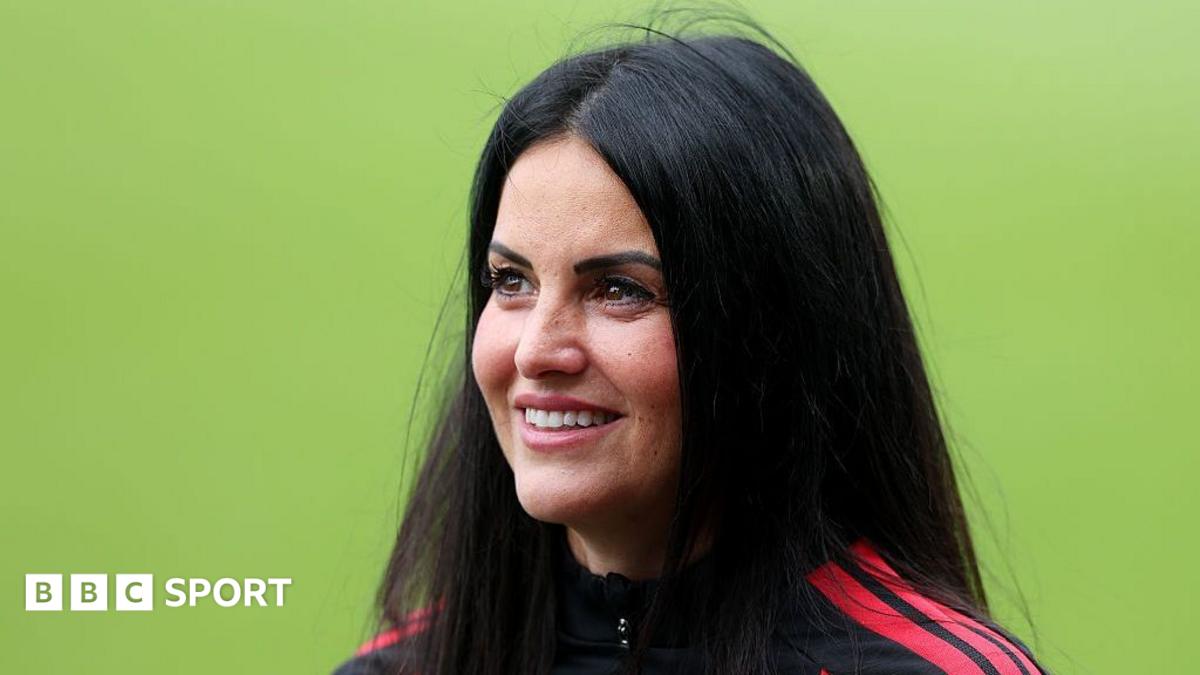
Eva Olid arrived at Manchester United famed for high‑possession attacking play, a philosophy she proved at Hearts.
Her first weeks in the WSL have been rocky, yet a 10‑1 League Cup thrashing of Sheffield United suggested she might be finding her footing.
United opened the season with a 2‑1 loss to London City Lionesses, then a 5‑0 drubbing by Chelsea, before salvaging a pragmatic 1‑1 draw with Arsenal.
So what is going on?
After that turbulent start we broke down Olid’s United, comparing her tactics to Marc Skinner’s legacy.
Man Utd put 10 past Blades as Olid gets first win
Olid’s Man Utd take big step forward after ‘intense week’
Olid wants United to build from the back, using short passes to avoid the gamble of long balls and to dominate possession.
Their buildup usually begins from a 4‑2 or 3‑2 shape, with the two central midfielders sitting close together.
The winger on the ball’s side stays high and wide, while the opposite winger drops deeper beside the number 10, forming a midfield box.
Skinner also favored a 4‑2 or 3‑2 base, but his principles differed markedly.
He tended to employ a wider, more symmetrical 3‑2‑2‑3, assigning players to relatively fixed zones.
His number 10s often lingered high, either to receive in danger zones or to pull defenders away.
Olid has abandoned that approach.
Her midfielders now have freedom to drift toward the ball, aiming to overload central areas.
If Park drifts inside, an opposing full‑back that stays wide hands United a numerical edge.
United now concentrate their play where it counts most.
When opponents sit in a zonal shape, crowding the middle gives United extra bodies; a compact defense then opens space on the flanks.
Skinner’s setup placed fewer bodies centrally, pushing possession toward the wings where triangles of full‑back, midfielder and winger formed.
Every system has trade‑offs.
Skinner’s rigid shape can be mirrored player‑for‑player, prompting Olid’s side to add another body for overloads.
Conversely, focusing on tight central combos risks losing the ball in dangerous zones, a vulnerability already visible under Olid.
Why has it not worked yet?
After three league matches United have held 37 % of possession; Olid flagged two issues: “We lose simple passes and we cannot recognise the free player.”
Goalkeeper Phallon Tullis‑Joyce has struggled with ball‑playing duties, and Chelsea’s pressure exposed that weakness.
She isn’t the only player adapting to the new, intricate system.
Olid’s plan seeks numerical superiority, yet United haven’t consistently found those advantages despite solid movement.
Her philosophy demands higher technical skill and quicker decision‑making.
Navigating crowded mids means receiving under pressure, combining in tight spaces and spotting the spare man – a test of chemistry more than a script.
Hinata Miyazawa and Julia Zigiotti‑Olme have shown the most promise, but building collective understanding will take time.
Chelsea’s fourth goal illustrated the trade‑offs as United lost the ball in the middle and were punished on the break.
For my money, Olid’s willingness to tweak her approach gives United a real chance to improve.
Recent data shows Tullis‑Joyce attempting longer passes, and against Arsenal, Awujo offered a more reliable target than Ella Toone.
That shift let striker Elisabeth Terland stay higher, rather than dropping deep for aerial duels.
Against Chelsea, however, the press was repeatedly exposed.
With Monica Jusu Bah on the left and Terland leading the press, the former drifted inside as the ball went wide to challenge Keira Walsh.
That movement freed Chelsea right‑back Ellie Carpenter to surge forward, while Wieke Kaptein kept United left‑back Andrea Medina pinned back.
In the second half Olid altered tactics: Terland dropped back beside Toone, shielding Chelsea’s midfield.
This allowed Jusu Bah to remain wider, limiting Carpenter’s space.
In the Sheffield United rout, United’s third and fourth goals stemmed from a coordinated press that forced a turnover near the opponents’ goal.
Implementing a new style is a marathon, especially when players must embrace risk and unconventional spacing.
Coaches often cling to an ideal model, ignoring squad realities—a common pitfall.
Olid appears to avoid that trap.
“The focus against Arsenal was defensive shape,” she explained. “It’s about giving the team confidence.”
Fluid, attacking football may be the endgame, but Olid is building toward it step by step.
She showed similar flexibility at Hearts, earning points, player trust and a platform for exciting play.
“The attack will come,” Olid said. “But we need to keep this defensive structure, then gradually become an attacking side, create chances, score more.”
The League Cup win hinted at progress, even though Sheffield United sit at the bottom of WSL 2 early on.
The real test will be how United carry this momentum into Sunday’s WSL clash with West Ham.