
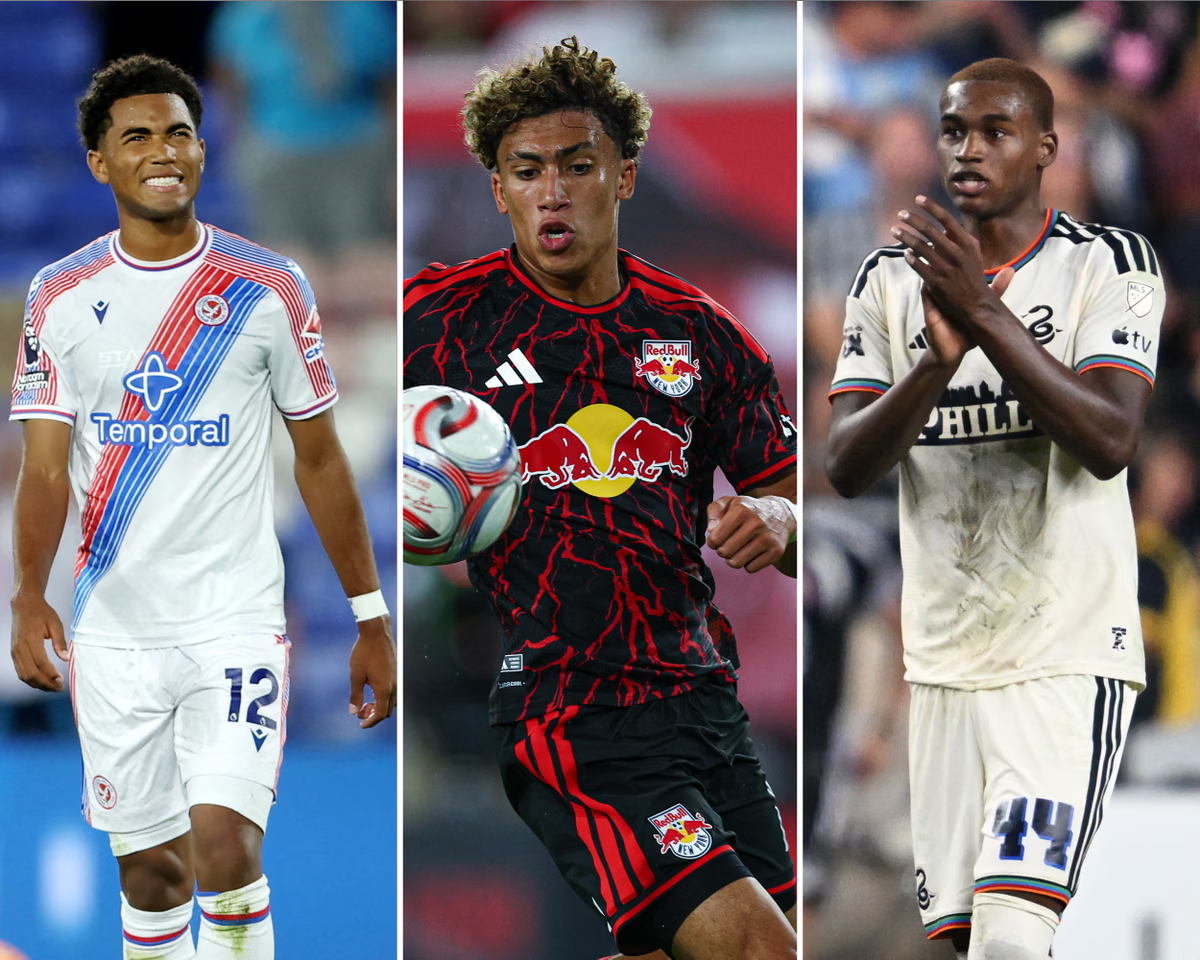
The next batch of USMNT stars will break onto the scene during the upcoming multi‑week FIFA window, with Pochettino inviting 13 players yet to earn a cap.
Sixteen‑year‑old Cavan Sullivan headlines the haul, and we’ve dug deep into what makes him stand out. He isn’t alone – think of this as a cheat sheet for every newcomer based on their club form.
All data pulled from Futi unless otherwise noted.
Kochen’s numbers may look modest, yet his profile intrigues a side that’s lacked a clear No. 1 since Tim Howard hung up his gloves. The Miami native trained with the World Cup squad and European scouts note his eagerness to claim crosses – a promising sign for a lanky keeper.
Schwake concedes just 0.81 goals per game, a stat that also reflects his backline’s strength. He still snags clean sheets despite a higher shot volume, offers solid cross‑claiming and distributes with precision, giving him room to grow in possession.
Right back has been a thin spot for the US for years, especially after Pochettino shifted Sergiño Dest to the wing. Enter Westfield, a former U‑20 World Cup player now anchoring Philadelphia’s defense.
Westfield embodies the modern full‑back: 3.62 crosses per 90 put him in the 98th MLS percentile, and he’s comfortable flipping play to the opposite side. His progressive passing sets him apart from peers.
Only three players – Carles Gil, Joaquín Pereyra and Lionel Messi – have logged more progressive passes this season; no defender cracks the top eight, making Westfield a potential answer to the US’s flank woes from the World Cup.
The 6‑ft‑7‑in tower was once hailed as the Union academy’s top centre‑back prospect, a claim that carries weight given the club’s pipeline of USMNT regulars like Mark McKenzie and Auston Trusty. After a loan stint at Lyngby, Pierre returned and quickly became a set‑piece threat.
Pierre isn’t just a target for aerial duels. Interim boss Ryan Richter lets him drive the backline’s passing, with 38 % of his distribution aimed upfield – an 88th‑percentile MLS figure. He’s a front‑foot defender, ranking in the 95th percentile for defensive actions and 97th for midfield ball wins.
The build‑up to this window has mourned Noahkai Banks’ choice to represent Germany after youth caps for the US. If Pierre sharpens his defensive and passing game, he could turn that loss into a footnote.
Since Alphonso Davies left for Bayern, MLS has produced several home‑grown left‑backs for Europe. Names like Caleb Wiley, John Tolkin, George Bello, Sam Vines and Kevin Paredes have had mixed success, with Luca Bombino and Max Arfsten recently moving to Stoke City. Miller arguably tops the ceiling among them.
If he stays on the wing, Miller’s goal‑scoring flair could be a rare asset for a left‑back. A two‑goal haul against Orlando lifted his season total to seven, plus four assists from clever cut‑backs and squares into the box. Those instincts would be valuable alongside Antonee Robinson.
Albert shares the spotlight with Cavan Sullivan as a headline attacker, yet while Sullivan enjoys regular MLS minutes, Albert remains a training‑only player, rarely featuring for Dortmund II.
Still, debuting in the Bundesliga younger than Christian Pulisic or Gio Reyna is impossible to ignore. A former LA Galaxy academy product, Albert rockets up the wing with uncanny acceleration, though his ultimate role – creator, finisher or advanced runner – remains to be seen.
In any other window, Gozo’s senior debut would steal the headlines; he may be the most likely of the dozen newcomers to stick around long‑term. Though sparingly used at Palace, his decisiveness and knack for crafting shots from dull moments make him a rare threat.
Gozo earned a late World Cup wild‑card nod after a scorching MLS start with Real Salt Lake. His dribbling tricks and right wing‑back bursts add versatility, giving Pochettino multiple positional options.
Mehmeti is arguably the league’s best midfield prospect since Tyler Adams, anchoring New York’s engine room. At a lean six feet, he leads the team in touches, linking defence to attack with poise rarely seen in a rookie who debuted in the 2026 opener.
His precociousness stems from clever positioning, constantly shifting his stance to keep opponents guessing. In the final third he threads through balls, and learning under Michael Bradley should fine‑tune his box‑to‑box game.
Raines, a 2028‑Olympics prospect, hails from Monrovia, Liberia, and honed his craft at the Barça Residency Academy – the same pipeline that produced Julian Araujo and Diego Luna. Playing right midfield for the Revolution, he passes cleanly with innate recycling instincts.
Only 22.1 % of his passes travel forward, the fourth‑lowest among 75 qualified midfielders. Instead, he often carries the ball into the attacking third, a prized trait for a possession‑heavy side facing compact defenses typical in CONCACAF. He ranks in the 76th percentile for progressive carries and can offer indirect set‑piece options.
Elversberg boss Vincent Wagner urges fearless play, a mantra that Houston native Campbell embraces. In limited action he’s already taking the initiative in the final third, preferring to shoot rather than simply distribute.
Ellis’s rise accelerated after joining Orlando alongside Antoine Griezmann. With just two MLS minutes before 2026, he’s already logged 11 assists this season, eight arriving after Griezmann’s post‑World Cup arrival.
Born in Wellington, Florida, Ellis quickly became the go‑to partner on Orlando’s counter‑attacks. He’s more “tricky” than outright pacey, using nimble bursts to outmaneuver defenders. Time will reveal whether he settles as a finesse striker or an attacking midfielder, but he already forces defenses to skate.
Hall’s early surge was so striking that Poland gifted his mother a national‑team jersey bearing her maiden name, Zakrzewski. The dual‑national remains undecided, yet Poland’s Jan Urban will watch his friendlies closely – four caps could lock his future to the US. Despite a dip after the Red Bulls’ summer slump, his 10 goals and five assists in 2,198 MLS minutes underline his impact.
Hall’s hallmark is an uncanny sense of space, slipping into scoring zones before anyone else spots them. While some forwards linger centrally or drift from half‑spaces, he roams side‑to‑side, finding pockets that yield eight of his ten goals from inside the six‑yard box.
He also earned a spot on last year’s Guardian Next Generation list – the next edition is on the horizon.