
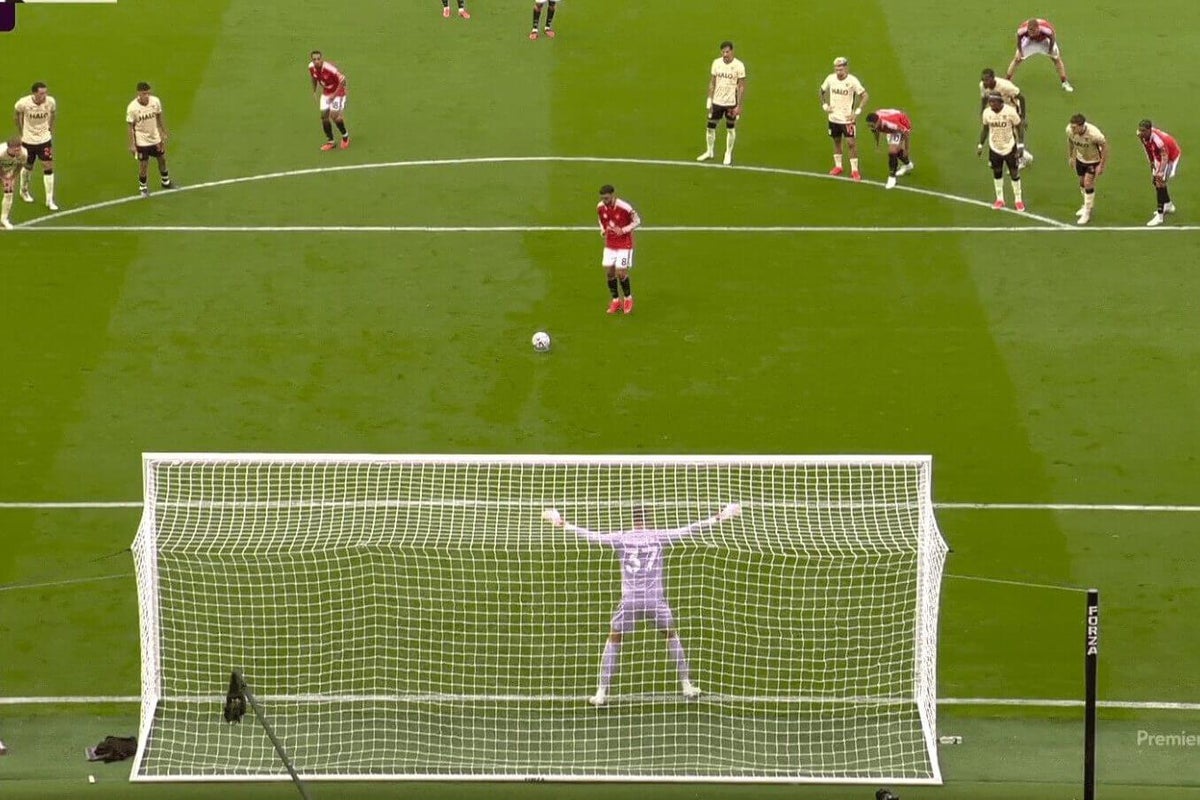
When Bruno Fernandes stepped up to the penalty spot on Sunday afternoon, all eyes were at first on him. Understandably so: Manchester United’s captain had missed two penalties in pre-season.
But after Fernandes duly converted for the second goal of his hat-trick against Ipswich Town, it was Youri Tielemans’ antics in the background that drew attention.
As Fernandes undertook his trademark run-up, Tielemans mirrored him exactly, sidestepping and stuttering in synchronisation.
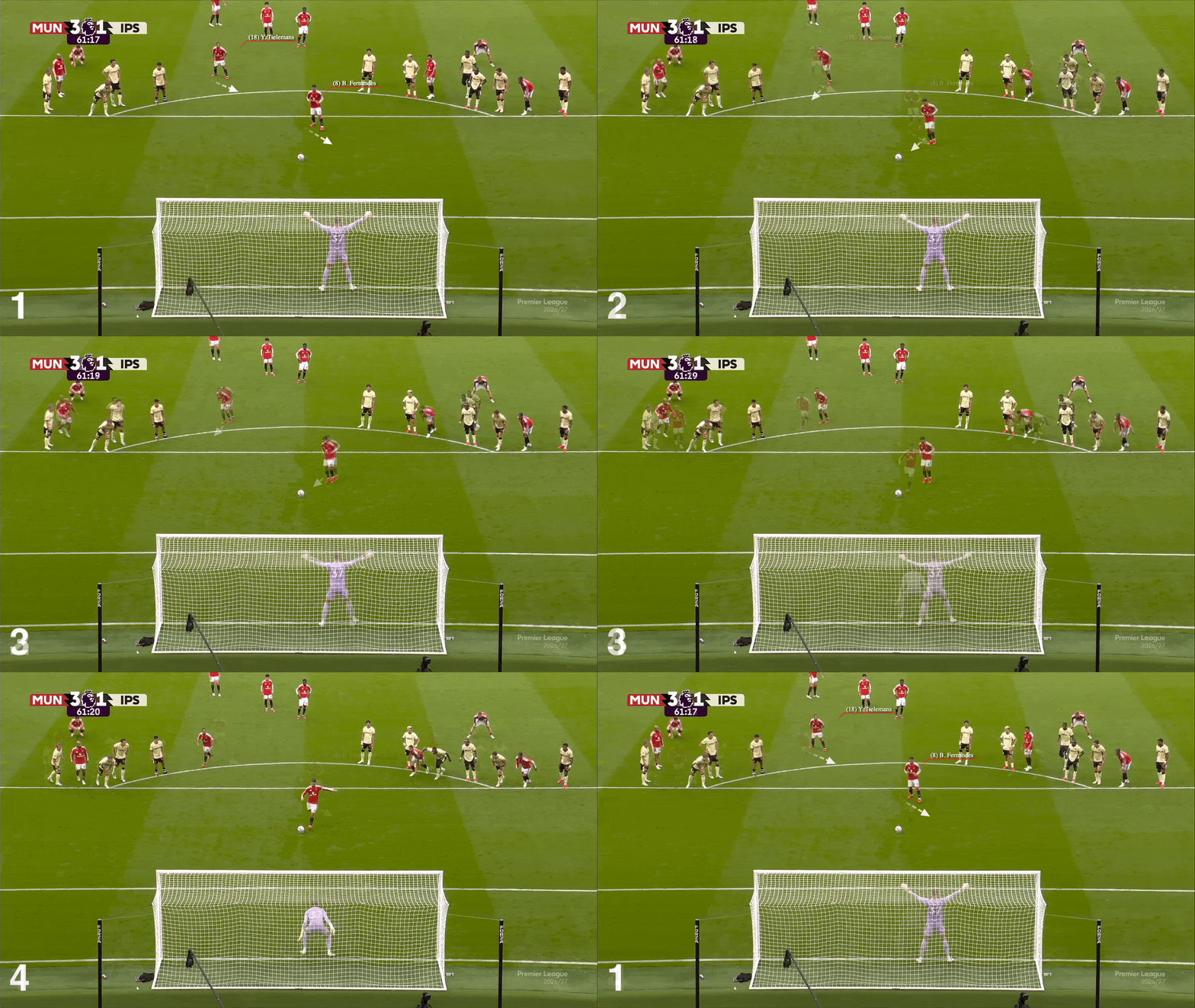
Here, in a 2025 FA Cup tie against Preston North End for Aston Villa, we see him mimicking Marcus Rashford, who was on loan at Villa at the time.
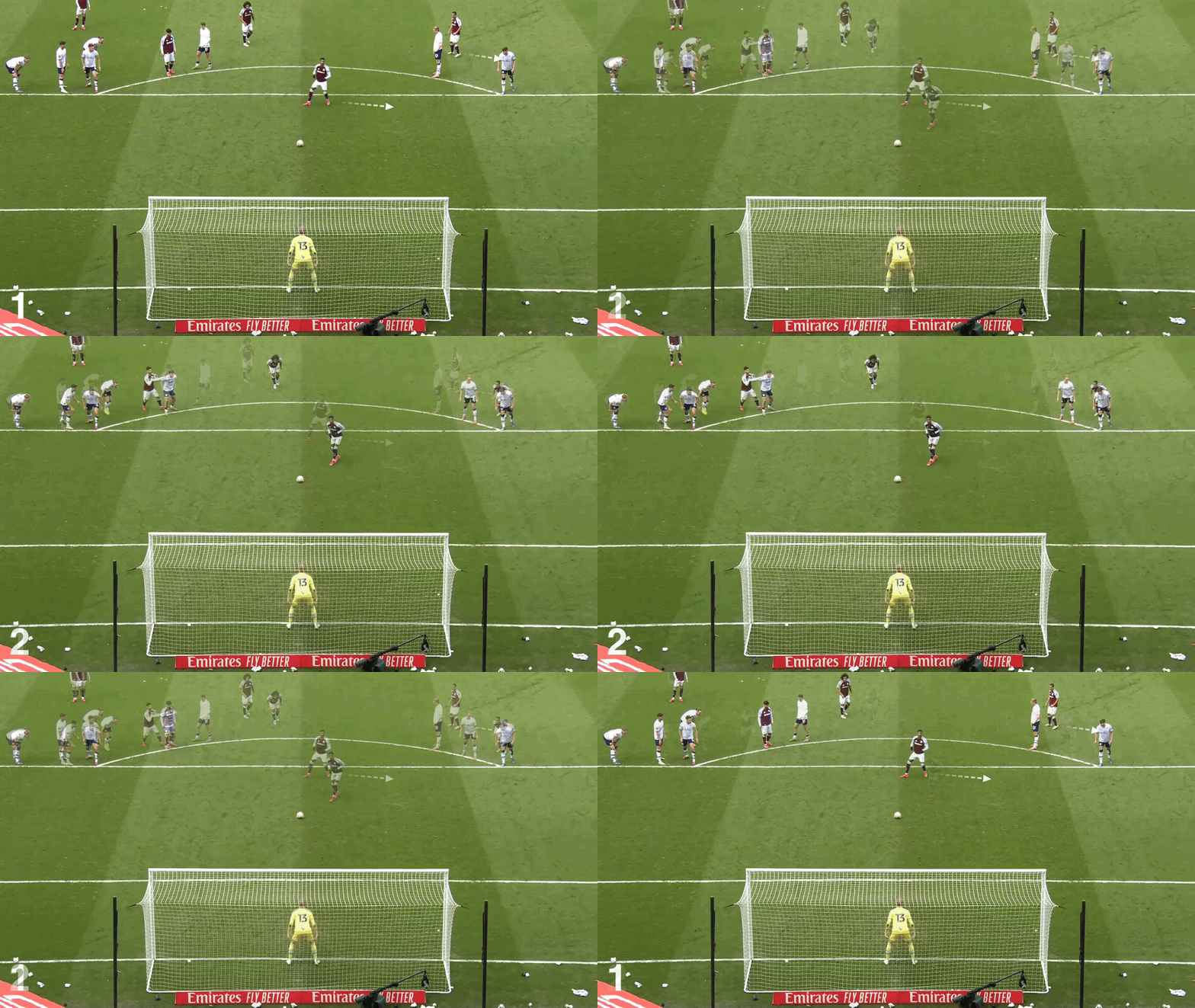
So what is the point of this odd-looking ghost run-up?
“The obvious one is to time your run for the rebound,” says Geir Jordet, penalty expert and author of the book Pressure, about the psychology of penalty shootouts. “Which is, in a sense, clever, because, particularly with a player like Bruno Fernandes, who often does his stuttered run-up for his penalties, you kind of need to follow him to get the timing right.”
Jordet explains that being already at speed and having momentum when trying to follow up a potential rebound is ideal. But if players other than the taker stray inside the penalty area or penalty arc before the kick is taken, and end up impacting whether the ball ends up in the net — for example, if they turn a rebounded penalty in — they risk the kick needing to be retaken, so timing of a run is crucial.
With a player such as Fernandes, who has a stuttered run-up, mirroring his movements can help Tielemans time his run perfectly.
@premierleague Youri Tielemans 🤝 Bruno Fernandes @Manchester United ♬ original sound – Premier League
“(Fernandes) makes his timing kind of scattered to make it difficult for the goalkeeper. So if you’re doing this type of, let’s call it a conventional rebound run, then you may also get the timing wrong, because you’re not paying attention to what the penalty taker is doing,” Jordet says.
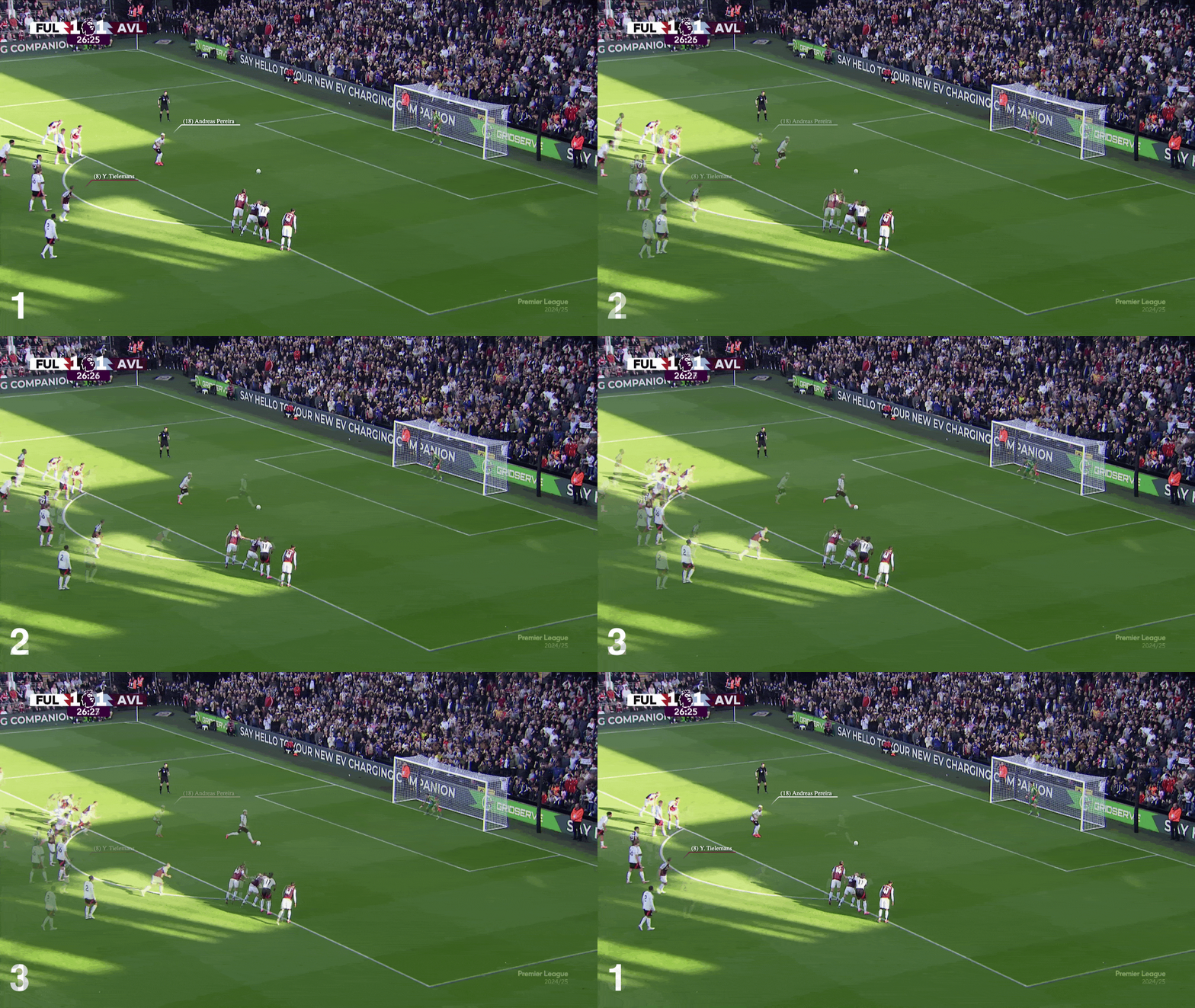
In a clip posted on United’s social media on Thursday morning, Tielemans confirmed he mimicked Fernandes’ run-up to help time his run into the box. He has used the same method to help defend penalties, too, such as here for Andreas Pereira’s spot kick for Fulham against Aston Villa in 2024.
As well as timing the player’s own run, there could be a welcome secondary effect: good old mind games and distraction. As Ben Lyttleton, author of Twelve Yards: The Art and Psychology of the Perfect Penalty Kick, points out, Ipswich Town goalkeeper Kjell Scherpen is trying out some mental manipulation of his own.
“Scherpen adopted a starting position clearly on one side of the goal — he was trying to distract Bruno by leaving one side of the goal open. I’ve seen this work before,” Lyttleton says. “On this occasion, though — and right in Scherpen’s eyeline — Tielemans was mimicking Bruno’s movements.
“I’ve not seen this before and I wonder if it did distract the goalkeeper, even more than if he had been standing centrally. The irony is that Scherpen was trying to get the upper hand himself.”
Jordet notes that just before the kick is taken, United’s Matheus Cunha actually draws Ipswich’s Issa Diop to the other side of the penalty arc, leaving a completely clear line of sight between Scherpen and Tielemans.
“That could of course also be to give Tielemans better access to the space for a rebound,” Jordet says, “or it could be to make him more visible for the goalkeeper. And this is the type of distraction that I kind of like.
“There are enough players who will wave their arms or say something, but it is unusual that someone is doing the same as the penalty taker. So in the corner of the eye of the goalkeeper, this could actually provide a little bit of a disruption.”
A quick trawl back through the archives reveals a few other players who make these ‘ghost’ run-ups. There are a few examples of Dominik Szoboszlai mirroring former Liverpool team-mate Mohamed Salah’s favoured sidestep and approach; Jordan Henderson has previously used a similar strategy.
In the example below, Manchester City’s defenders seem wise to the tactic and aim to prevent Szoboszlai from a clear run into the box.
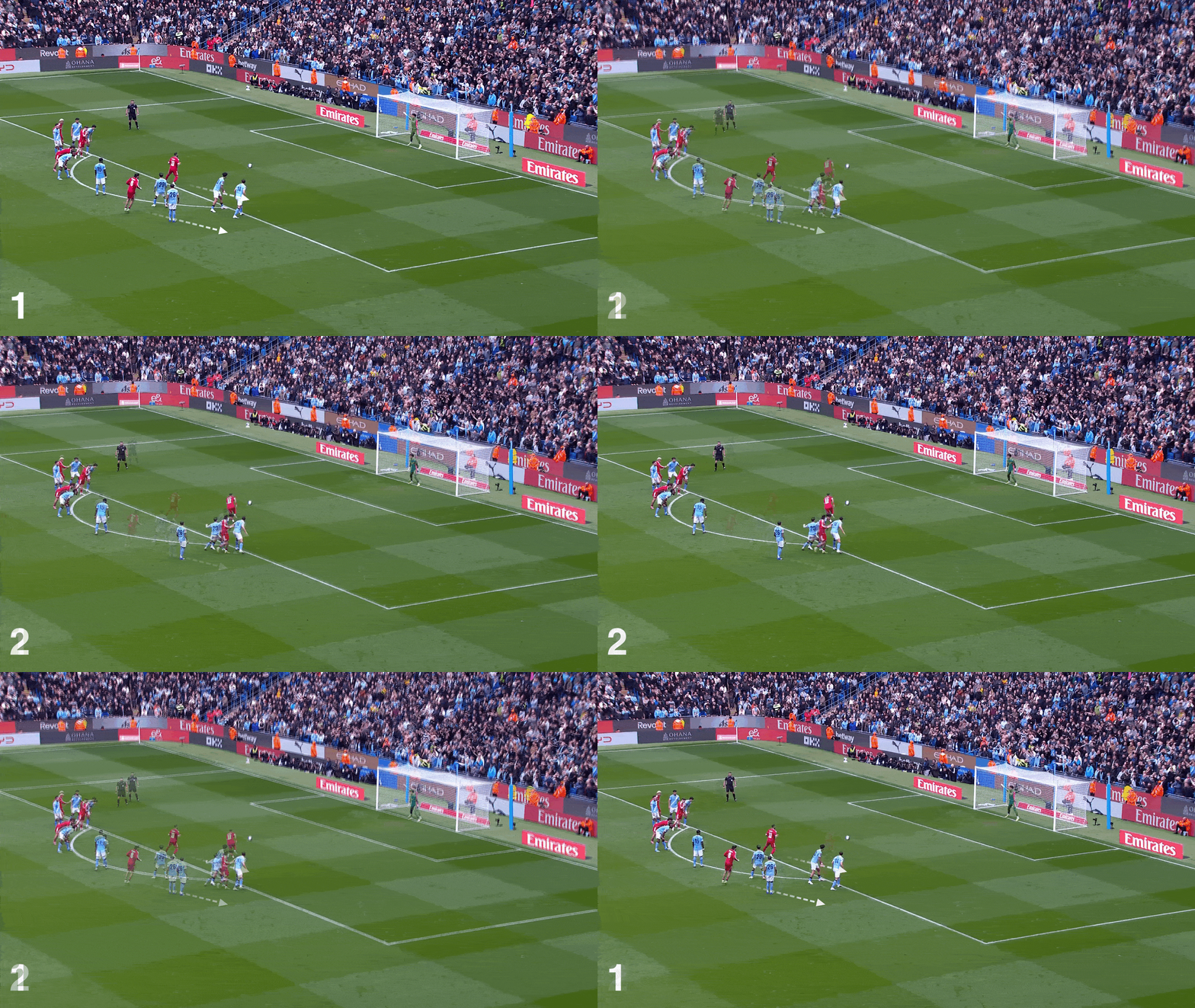
Tielemans’ former Aston Villa team-mate Amadou Onana also appears to mirror Rashford’s run-up in a game against Manchester City in 2025. There is also an example buried in an FA Cup classic for Coventry City: as Haji Wright scores the penalty that forces extra time against Manchester United at Wembley in 2024, his team-mate Callum O’Hare (now at Wrexham) can be seen shadowing his run-up.
It is a fairly uncommon trick, but should it be?
“If I were a goalkeeper and I had the choice between having opponents either standing still,” Jordet says, “or a series of opponents moving around the box and timing their runs perfectly because they’re basically emulating the penalty taker, I would definitely choose to have stationary opponents every day.”
Footballers are constantly seeking the next gimmick that will help them exploit any fine margins in the game — and the numbers actually reveal penalty rebounds as an area for potential improvement.
In the past five Premier League seasons, there have been 484 penalties, 400 of which have been scored. Of those not converted, 22 have been off target and 62 have been saved by the goalkeeper. Of course, some of those saves will have seen ‘keepers hold onto the ball or push it out of play, but others will have presented an opportunity for a rebound. It’s rare for teams to take advantage: only 11 goals have been scored from rebounded penalty kicks in the Premier League over the past five seasons. All but two of those have been scored by the original taker.
Is there a chance for players outside the area to get more creative with their contribution to penalties?
“I’m curious to hear what Tielemans says about it and whether we’ll see it again in the future,” Lyttleton says. “Will a different player do it next time, or two players, one on either side of the penalty-taker? Or a choreographed five-man penalty routine? At what point will the referees have to get involved? I’m always up for new penalty methods but this one could get interesting — or more likely, will be regulated and clamped down quickly. But it was smart and original work from Tielemans!”
“It seems, when you think about it, almost stupid to just stand there,” Jordet says, “when you can do something to more actively position yourself and disrupt the goalkeeper.
“Why not do these things? Teams should be doing more of this. It’s such a critical situation for goalscoring and for the result of these games.”