
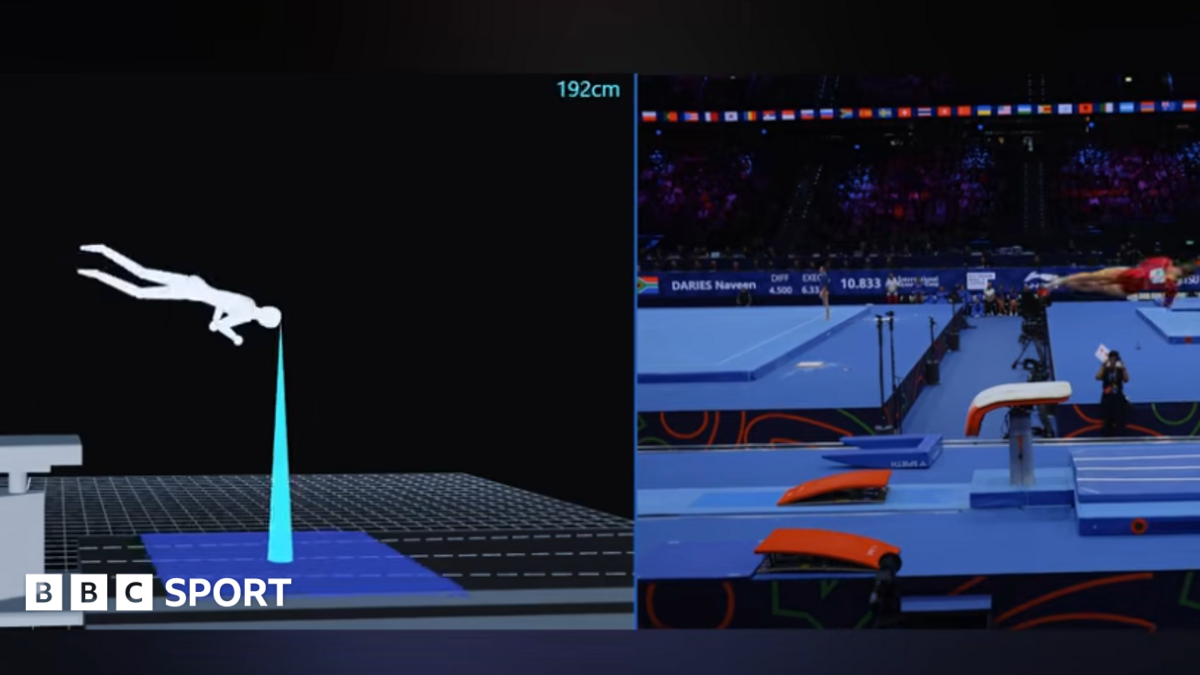
Gymnastics is at the forefront of AI‑driven judging, and its impact could shape medal outcomes in Los Angeles 2028.
Officials say they’d be shocked if AI‑assisted scoring isn’t on the 2028 agenda.
Some top gymnasts slammed the technology at the World Championships, insisting they’re not machines and warning of risks.
Olympic champion Carlos Yulo and Brit Harry Hepworth saw their vault difficulty scores cut during qualifiers.
Both attempted the piked Dragulescu, dropping from a 5.6 to a 5.2 rating.
They repeated the vault in the final; Hepworth placed sixth, Yulo fell to seventh.
The AI system flagged his position as a tuck, trimming four‑tenths from the score.
He believes that cost him several spots in the final.
Reflecting on Yulo’s case, he noted the irony of a bronze‑medal vault being downgraded by the same AI.
In the final he aimed for straight legs, but the difficulty led to a fall and safety concerns.
Yulo expressed disappointment over the downgrade.
“I don’t get it,” he told Inside Gymnastics. “It’s AI, not a robot. We’re human, and the pike reading seems off at 5.2.”
For my money, AI could bring the fairness athletes deserve, says Andrew Tombs, MEN’s Artistic technical chief.
He added that judges would have lowered the difficulty even without the Judging Support System.
He noted lessons learned and ongoing talks with coaches about the optimal moment for AI measurement.
“The championship calls were correct according to the system,” Tombs affirmed.
Will AI judging replace humans?
The JSS, an AI tool developed by Fujitsu since 2017, powers this analysis.
It blends motion capture with multi‑angle video to give judges precise, objective data.
Over 800 elements, including body angles and leg bends, are encoded in the platform.
“A one‑degree shift between straight and piked matters,” Tombs explained.
“When margins are razor‑thin, JSS helps judges nail the right call on body angles.”
“It’s a major shift for our sport’s judging,” he said, recalling Rotterdam’s positive results.
Continuous upgrades are part of the plan.
“We’re consulting coaches to pinpoint the biomechanical sweet spot for assessments,” he noted.
“Future tweaks will fine‑tune leg‑angle timing, adding flexibility to today’s process.”
Hepworth sees JSS benefits but urges further refinement.
“It makes you wonder if extreme vaults are worth it if they get downgraded automatically,” he mused.
“But with improvements, it could become a brilliant tool for the sport.”
Related topics
Other judged events like dressage, freestyle skiing and snowboarding are testing AI support.
Their aims focus on fairness, accuracy, integrity and cutting subjective ambiguity.
They also hope AI will make scoring clearer for casual viewers during the quadrennial Games.
Equestrian, skiing and snowboarding federations are prepping pilot AI projects.
Winter sports will first trial AI in aerials alongside judges, then possibly expand to halfpipe, slopestyle and big air.
The FEI plans AI trials in dressage World Cups.
However, dressage’s horse‑rider harmony poses limits, officials say human judges will remain essential.
“Judging isn’t just technical execution; it’s about movement quality and horse‑athlete harmony,” noted Ronan Murphy.
“AI can’t yet assess those nuanced qualities,” he added.
AI might also monitor horse welfare, like checking nose‑line alignment behind the vertical.
“Technology could aid welfare reviews,” Murphy suggested.
“But rigorous validation and veterinary input would be required,” he cautioned.
Murphy admitted it’s hard to predict AI’s role at LA28.
“If AI proves beneficial, we’d consider it for the Olympics and major events,” he said.
Will AI judging replace humans?
FIS secretary Urs Lehmann wants AI to cut judging delays between athletes.
He measured aerials judging at roughly one minute 45 seconds per competitor.
“We aim for 15‑20 seconds max to keep the show flowing,” he explained.
“AI offers precision without crowd influence,” he asserted.
“By 2029 we expect AI to handle most of our disciplines,” he projected.
World Gymnastics chief Morinari Watanabe envisions computers scoring everything someday.
Tombs warned that fully removing judges is still far off.
“Mori is visionary, pushing gymnastics forward,” he said, praising the push for visibility and transparency.
“JSS and real‑time judging will boost integrity, but it’s not imminent.”
How does AI‑assisted judging work?
Which other Olympic sports are considering it?