
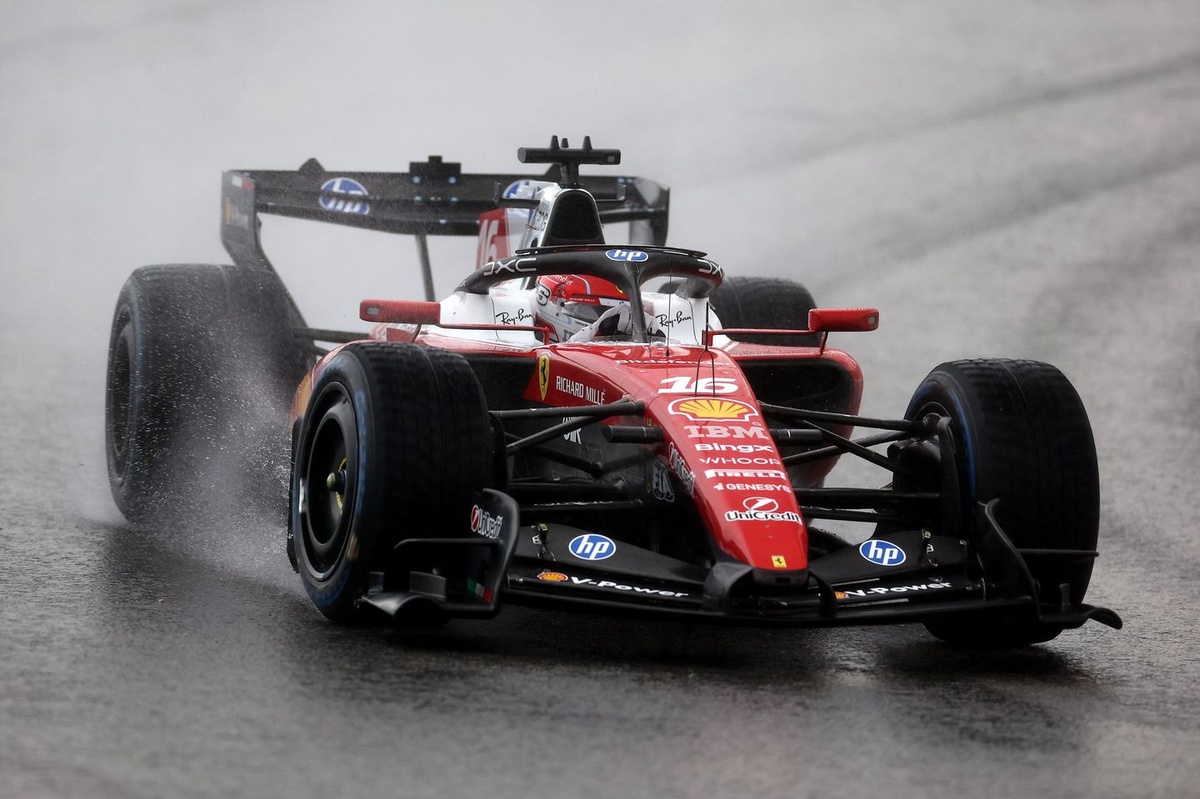
Can F1 truly master a rain‑splashed race? The prospect of a wet Grand Prix has haunted teams since the season’s start, sparking overblown chatter that peaked at last weekend’s Interlagos event, where rain was almost guaranteed for both qualifying and the race.
Bahrain’s Malaysian round saw rain and a software hiccup, yet the circuit dried fast once the lights went green. Brazil offered no such reprieve.
Interlagos qualifying was halted for 80 minutes after a sudden downpour, and media outlets latched onto a fiery George Russell remark afterward.
“I love the rain here, but if it turned into a race the risk of a horrific crash would be enormous,” he warned.
The headline grabbed attention, but missed nuance. Most in the paddock agreed the FIA acted correctly, suspending Q1 immediately and meticulously scouting a safe window to resume.
“I’m always eager to race, but Saturday’s decision was spot‑on,” Ferrari boss Frederic Vasseur said post‑race.
“During our first Q1 lap before the red flag, we returned with two centimetres of water inside the car…”
Charles Leclerc, Ferrari; Carlos Sainz, Ferrari; Arvid Lindblad, Racing Bulls; Williams
The track was too soaked for any activity beyond a boat race in the pit lane. The real debate centred on how the cars and the latest tyres would cope with rapidly shifting wet conditions.
Pirelli’s heavily treaded ‘extreme’ wets rarely appear because their optimal window lies outside acceptable racing limits. They shove water away but overheat quickly as the surface dries, and a red flag usually follows once conditions justify their use.
Thus teams favour intermediate tyres, yet this year’s compounds feel too hard and sluggish to reach temperature. Pirelli struggles to match performance with the season’s narrower wheels under testing caps.
There’s been a long‑standing fear that the new intermediates, paired with the harsher torque of modern engines, could render 2026 cars nearly undriveable in the wet – fueling the pre‑Brazil hysteria. In my view, the alarm was exaggerated.
In reality the weekend was more subtle. Interlagos’ surface sometimes hampered grip, but not uniformly. Behind the scenes the FIA has been tweaking power delivery for such conditions since the year began.
Alexander Albon, Williams; Carlos Sainz, Ferrari
When qualifying finally resumed, the ‘extreme’ wets showed promise, yet the intermediates remained tricky. Kimi Antonelli slid off at Juncao, and several drivers found the cars a handful as rain returned in the final ten laps, forcing a switch back to intermediates.
“It’s encouraging we can now deploy the big wet more often,” Vasseur noted. “That means we’re not forced to gamble with intermediates in heavy rain, reducing risk.”
“Qualifying felt solid, but the grip was alien. By the final lap to the grid everyone was battling like hell on a demanding circuit,” he added.
Pirelli aims to narrow the performance gap for next season so intermediates heat up quicker and ‘extreme’ wets resist wear longer, a tough task given the diverse energy loads each track imposes on the rubber.
“They struggled to fire up and wore out fast,” said Alex Albon, who finished 15th in Brazil.
“Even when cold they wear down, never overheating or reaching a stable temperature. By the time you’re up to speed the tread’s already gone, leaving you sliding constantly. It never feels alive during the race,” he explained.
That explains the odd opening laps: front‑runners had to be ultra‑cautious lacking grip, while some back‑markers, who waited less for the start, launched with vigor.
Variations persisted: Max Verstappen and Lewis Hamilton surged from 20th and 21st to the top ten, only for Hamilton to lose ground as his car developed severe oversteer. Verstappen, like Antonelli, later found the slicks under‑performing.
Wet qualifying added drama to the weekend.
The mixed performance of wet and dry compounds will be hard to untangle, but the consensus is clear – the rain tyres need further development. Minor gripes surfaced, but the feared catastrophes never materialised.
“The wet and intermediate levels aren’t sufficient; we must work with Pirelli for a better tyre,” Carlos Sainz argued. “In mixed conditions the intermediate remains weak at the rear, and by the time it heats up the front is already gone.”
“And the extreme tyre, honestly, gave us massive sliding and rear‑grip loss yesterday – it still needs development,” he added.
Data from Brazil will prove useful, yet it remains a single case. What works at Interlagos may not translate to other circuits with different surfaces and temperatures.
“Quite tricky,” summed Liam Lawson on handling a 2026 car in the wet.
“The biggest issue today was the cooler ambient temperature compared to yesterday. Less water was on track, yet the cars were nearly undriveable on the grid laps as temps kept dropping,” he said.
“We survived the race start, but when heavy rain hits, the intermediate struggles not because of standing water but because it can’t maintain temperature. On a track like Vegas, that would be disastrous,” he warned.
“Overall we managed to get through a weekend with these tyres for the first time,” he concluded. If progress continues, 2027 may finally deliver truly competitive wet tyres.
We want your opinion!
What changes would you like to see on future wet‑weather tyres?
Take our 5 minute survey.
– The Team