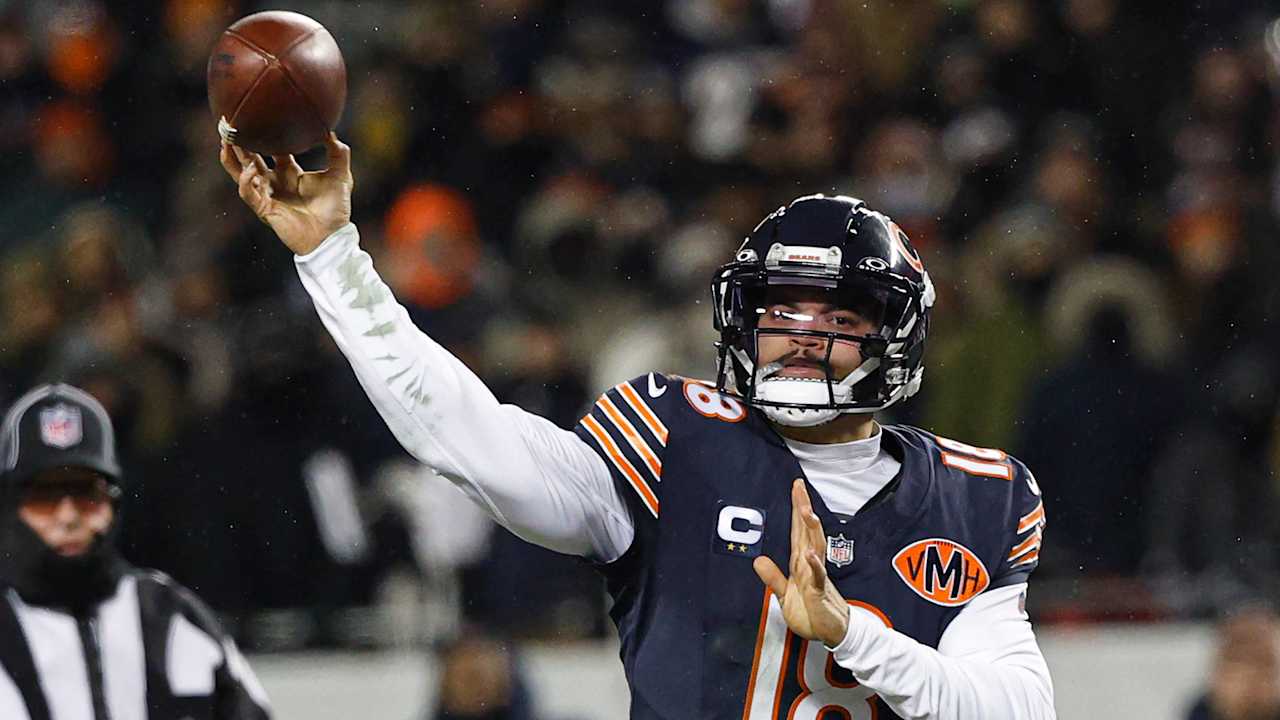
While the Bears’ first playoff berth since 2020 has depended on Williams doing the impossible late in games, often buying time this way and before unthinkable plays were taken out of bounds at junctures, the need to do so was caused by early-game inefficiencies.
For all his jaw-dropping shots, Williams missed too often, didn’t see or take the easy ones.
His completion percentage in his first year under head coach Ben Johnson actually dropped from 62.5 as a rookie to 58.1, above only JJ McCarthy of the Minnesota Vikings and 6.2 shy of the league average. His -6.9 completion percentage over projection was the worst in the league among players who attempted at least 200 passes, 1.7 worse than McCarthy, who was the only other such QB to break -4%. Williams’ time to throw was 3.20, eclipsed only by Shedeur Sanders of the Cleveland Browns.
There were some mitigating circumstances at times — Chicago was notably tied for the fourth-highest drop rate at 5.1 — but Barrett noted that Williams could conserve energy by simply ditching some of his wilder plays in favor of hitting open passes underneath.
Doing so would see Williams’ completion percentage climb and keep the offense going through all four frames.
“Late in some of those games we were playing heroically … but it wasn’t necessary if we came out ahead in the first and second quarters,” Barrett said. “We might have been within two touchdowns by the time we got to the fourth quarter.”
“We can be efficient and take what the defense gives. You don’t necessarily have to put the cap on and make those crazy plays because you were already killing them in the first three quarters.”
Williams making the leap to stability is the next critical step for the Bears to continue their success from their 11-6 run to the top of the NFC North.
No matter how big of a fourth quarter he had in 2025, wins will only come consistently from year to year by reducing the frequency of the need for late-game heroics.
If Williams can do that, the league would be in trouble.