
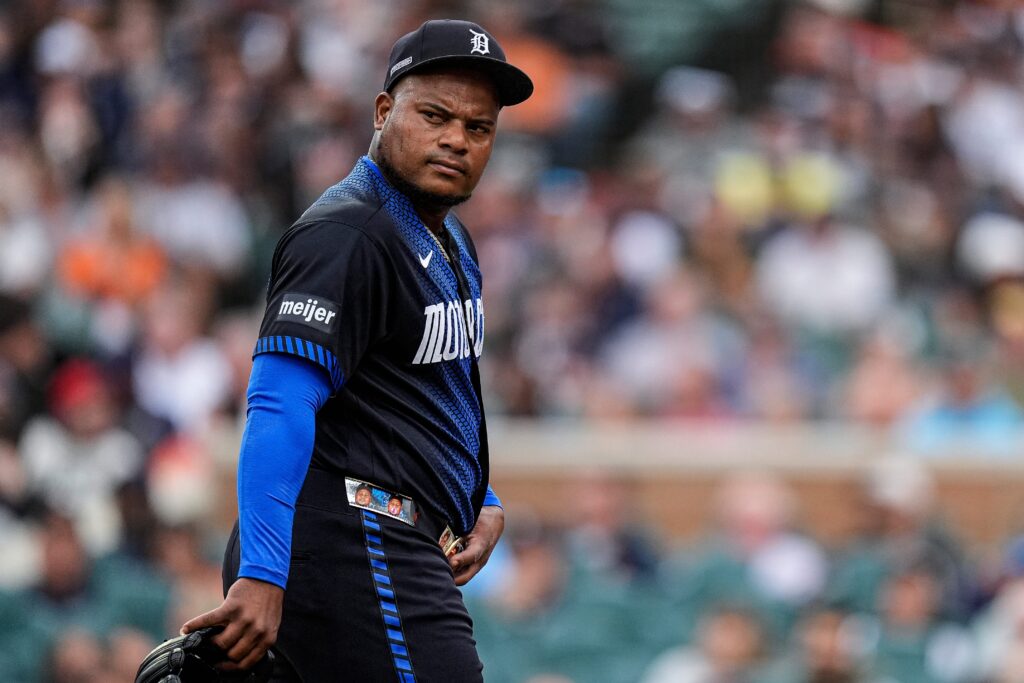
The Tigers inked left‑hander Framber Valdez to a three‑year, $115 MM contract, the third‑largest free‑agent starter deal last winter. He was meant to pair with two‑time AL Cy Young winner Tarik Skubal. Did Detroit overpay for a lefty who never clicked?
Valdez’s first season in Detroit was underwhelming. His 4.03 ERA marked his worst mark since becoming a full‑time starter in 2020, and his strikeout rate sank to a career‑low 17.8%. Meanwhile, his walk rate rose to its highest level since 2021. He wasn’t the sole cause of the Tigers’ missed postseason, but his instability left the rotation scrambling for a reliable workhorse.
A glaring warning sign was his 56.3% groundball rate. While still well above the league’s 44.1% average in 2026, it fell short of Valdez’s career norm of 61.5%. That figure was his second‑lowest as a big‑leaguer, trailing only 2023, and it coincided with a modest bump in strikeouts that season.
Groundballs at a league‑leading pace usually mask hard‑contact issues. Valdez consistently ranks in the bottom decile for hard‑hit rate and exit velocity, so inducing grounders limits damage compared with line drives or fly balls. His WHIP often exceeds that of other aces, yet his ERA typically settles in the low‑to‑mid 3.00s when he leans on this approach.
Fewer grounders meant more balls in the air, especially to the pull side. Valdez posted a career‑high 16.4% pulled‑air rate, near the league average but well above his 10.7% career norm. The shift produced a .258 batting average against and a .370 slugging percentage. For my money, the drop in groundballs hurt him more than any other factor.
Never a strikeout powerhouse, Valdez usually hovered around a strikeout per inning. In 2026 his 17.8% rate fell below the 21% benchmark he’d maintained as a starter, paired with a brutal 8.7% swinging‑strike rate that ranked 42nd of 46 qualified starters.
His primary breaking ball, the curve, lost its bite. The whiff rate slipped to 31.8%, far below the 39.8%+ he’d enjoyed each season since his 2018 debut. The pitch also arrived about 1 mph slower than the year before, with a slightly steeper vertical drop and reduced horizontal break—enough to raise eyebrows.
On the intangible side, Valdez lacked his signature “heater” stretch. Typically he strings together a dominant run where his curve clicks and he flirts with a no‑hitters. In 2025 he posted a 1.93 ERA from June through July, and he surrendered just 11 earned runs in his final nine starts of 2024. This season, aside from a 1.93 ERA over four September outings, that vintage streak never materialized.
These 2026 flaws aren’t irreparable; they’re merely a collection of off‑kilter pieces. The pressure of a big new contract likely played a role, especially after the departures of Skubal, Casey Mize, Jack Flaherty and Justin Verlander. Detroit will need an “Astros‑style” Valdez to step up in 2027.
Photos courtesy of Junfu Han of USA TODAY and Charles LeClaire, via Imagn Images