
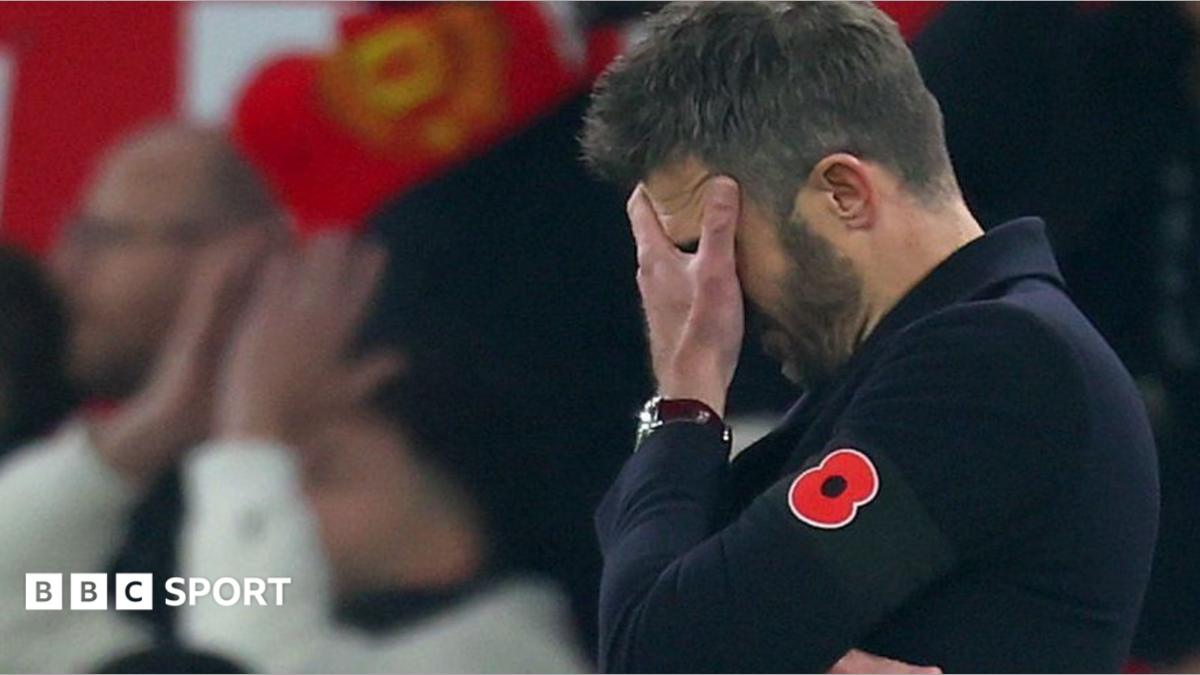
Just after 6 p.m. on Sunday, 8 November, the news hit: United trailing 4‑2 to Aston Villa, defeat looming at Old Trafford. Could anything have saved them?
“Be gentle.”
A close associate of Michael Carrick, who’s worked alongside him, urged patience, knowing the intense scrutiny at United’s helm.
The foretold downfall never materialised that night.
United struck twice in stoppage time to force a 4‑4 draw, and Carrick lifted his arm for Patrick Dorgu’s equaliser before taking a final lap of appreciation around the pitch.
Amid chants of his name, Carrick positioned himself amid his players, shielding them from the anger that followed the earlier 3‑0 Bournemouth loss.
That choice summed up the 45‑year‑old’s ethos – championing the group over personal glory.
His genuine commitment explains why fans kept singing his name while others at the club faced scorn.
In the end, it wasn’t enough.
Reaching this point took longer than many imagined; the Bournemouth disaster seemed irreversible.
United announced 44 hours later they were backing him, though Carrick learned of it a day earlier.
Chaos has reigned since: one win, one draw, one loss.
A strong first half at Chelsea gave way to a second‑half collapse and Lisandro Martínez’s red card, ending in a 2‑0 defeat.
Down 2‑0 early against Roma, United roared back to win 3‑2, echoing Carrick’s classic comeback flair.
Against Villa, they fell two quick goals but fought back to level before half‑time and salvaged a point after a chaotic defensive display.
Pick apart those games – did his reputation rise or prove he was the wrong fit? United decided the latter.
CEO Omar Berrada and director Jason Wilcox celebrated Dorgu’s late equaliser from the directors’ box, but their view was detached.
Within days they flew to Monaco to urge minority owner Sir Jim Ratcliffe to enforce change.
For the third straight season, United have sacked their manager mid‑campaign.
Unlike the surprise surrounding Ten Hag or Amorim, this move felt inevitable given the stark contrast with last season’s promise.
After 12 wins in 17 games under Carrick and a Champions League return, pre‑season optimism ran high.
No signs of division; youngsters like J.J. Gabriel featured, and staff praised a potential Fernandes‑Tielemans partnership.
Recruitment was shaky, but that story unfolds later.
The 48 hours before the Hull opener proved decisive.
With Benjamin Šeško nursing a shin issue and Amad Diallo out for seven weeks, Carrick lost his primary striker, forcing Bryan Mbeumo onto the right flank.
He turned to Matheus Cunha, whose tendency to drop deep clashed with Fernandes’s preferred zones.
That tactic blunted United’s attack on a physically demanding day against a newly promoted side.
In a Viaplay interview, former striker Jan Aage Fjortoft claimed United lacked passion – a charge Carrick dismissed as “ridiculous”.
“It’s just one game,” Carrick told reporters afterward.
United have not won a Premier League match since.
Next came Everton: United led twice, with Šeško netting two minutes from the end after coming on, only for Ainsley Maitland‑Niles to strike late and deny them.
When asked about confidence, Carrick snapped, “It’s not been that bad.”
What followed was a cascade of setbacks.
Fitness concerns haunted United repeatedly, and they fell hard to a ten‑man Manchester City, who later benefited from a disallowed Haaland goal, as Howard Webb admitted.
Carrick’s post‑match complaints were valid, yet they veiled a team‑wide poor showing.
After an early 2‑0 lead over Brighton in the EFL Cup, United wilted and lost by two goals in the second half.
His coaching staff, praised months earlier, failed to produce solutions.
Cunha’s injury‑time equaliser against Fulham was hailed as a positive, but United then drew again, conceding late to a struggling, ten‑man Tottenham.
The familiar slide accelerated out of control.
Martínez’s error led to Spurs’ leveller, making his outburst after the 2‑0 Atlético loss all the more striking.
The Argentine defender blamed the club’s summer signings on “the technical director” – Jason Wilcox.
By then, Šeško and left‑back Luke Shaw were injured, Rashford hadn’t featured, and Carrick rotated five different left‑backs.
After conceding early to Atlético, Como struck twice in two minutes of a 4‑1 defeat; Fernandes then lambasted Carrick’s tactics.
He was dropped for the Bournemouth clash but returned as captain at Chelsea.
In my view, the Hull loss was an unforgivable start.
It’s also fair to question how much the faulty recruitment let him down.
A source close to a player wondered why midfield dominated attention, pushing Fernandes out of his best central role.
Casemiro’s exit forced a costly hunt, and after fruitless pursuits of Elliot Anderson and Mateus Fernandes, the £70 m Carlos Baleba deal finally closed on 25 August.
Baleba’s pre‑existing ankle issue delayed his debut until 10 October; after five starts, a hamstring injury sidelined him long‑term.
Tielemans arrived from Villa for £35 m and Andrey Santos from Chelsea in a deal that could reach £50 m; Tielemans scored in the Villa thriller, while Santos has mostly sat on the bench, starting four league games.
Meanwhile, glaring gaps in Carrick’s squad remained unfilled.
Shaw played every league match last season, an outlier in an injury‑prone career; United needed competition but hoped to sign Lewis Hall next summer instead.
Central defence stayed unchanged.
United’s back four for the first home game mirrored Ten Hag’s 2022 lineup; they have now conceded 30 goals – the worst among Europe’s top five leagues, save Lens.
Up front, Šeško ended last season injured, making only two substitute appearances before the window shut; Carrick later admitted his absence would stretch into at least January.
When asked about further signings after Tielemans and Santos joined the pre‑season camp on 13 August, he replied, “We want more, we need more.”
For a man usually measured, that was a clear demand to the hierarchy.
Insiders say Carrick clearly identified squad holes and expected more than a single new player.
From that stance, the verdict would be negative.
Other United voices defend the transfer plan, noting it’s easy to judge in hindsight and that Kobbie Mainoo was their sole traditional midfield option at season’s end.
They also argue the squad can still aim for Champions League spots.
More than a quarter into the campaign, they remain far from that goal.
Carrick paid the price, exiting in under six months of his two‑year May contract.
Mauricio Pochettino will replace him, while Berrada and Wilcox hope his arrival restores stability after another chaotic spell.