
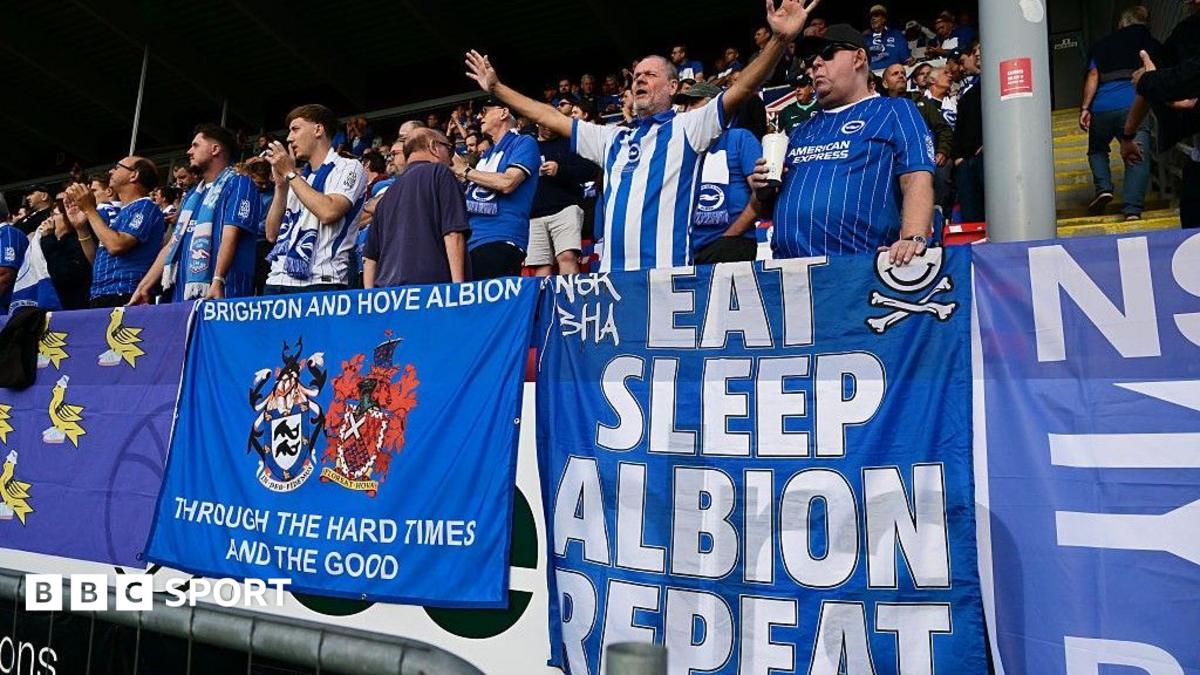
Brighton‘s 125th anniversary celebrations could not have gone much better—right?
Wearing a bespoke commemorative kit, Hurzeler’s men delivered a performance worthy of the milestone.
A home clash with Arsenal threatened to dampen the mood, yet Brighton stunned the title‑holders.
A record 31,944 fans packed the Amex Stadium, cheering a dominant 3‑0 victory.
Pascal Gross opened the scoring, Charalampos Kostoulas doubled the lead at half‑time, and Chema Andrés headed the third after the break.
They could have added more, but three was ample.
“It was special, not just for facing perhaps England’s best, but for how we played,” Hurzeler told BBC Match of the Day.
“The lads started ferociously, won their duels, kept possession tidy and forged chances.
“I’m proud of my squad; I hope they relish this moment, because such occasions matter.
From near‑oblivion to Europe and toppling England’s champions on a landmark day, the Seagulls’ tale is extraordinary.
It is Thursday, 9 November 2023. Manager Roberto de Zerbi addresses his squad in the Amsterdam Arena ahead of the Europa League tie with Ajax.
“There are 3,000 Brighton fans here tonight,” the Italian noted. “More than twice that number have travelled from the city—remember that on the pitch.”
A senior Brighton official, a lifelong supporter, had been with the club for almost three decades.
“It gave me goose‑bumps,” he recalled.
For many clubs an Ajax fixture is routine. Not for Brighton.
“The royalty of European football,” the official mused. “Coming from where we did, being in that setting feels like a pinch‑me moment.”
Brighton triumphed 2‑0, marking the high point of their inaugural European campaign.
Paul Samrah’s most vivid memory as a Seagulls fan isn’t a goal but the struggle that shaped the club’s identity.
August 2007. “After years of campaigning, fighting for change and a new stadium, hearing we finally got planning permission was exhilarating,” he said.
“We’d won our battle.”
These two anecdotes contrast Brighton & Hove Albion’s before‑and‑after narrative.
For years they were known outside Sussex for the infamous “And Smith must score…” BBC commentary during the 1983 FA Cup final, when Gordon Smith’s chance was saved by Manchester United’s Gary Bailey.
In 1995, chairman Bill Archer sold the Goldstone Ground amid mounting debts, without consulting fans or securing a replacement venue.
The club lingered until 1997; the final Goldstone match was abandoned after thousands stormed the pitch, snapping both crossbars.
After two seasons 70 miles away at Gillingham and a failed stadium plan in Toad’s Hole Valley, Brighton returned in 1999 to the Withdean, famous for Olympian Steve Ovett’s track.
That brings us back to de Zerbi’s pre‑match talk in Amsterdam.
More than 7,000 Brighton supporters were in Amsterdam that night, surpassing the Withdean’s 6,000 capacity—today’s club is a different beast.
“After the 1983 final, players left, investment vanished, the Goldstone decayed and crowds fell,” Samrah explained. “There was no board‑fan dialogue, constant turnover, no direction—we were rudderless.”
Several notable figures have shaped Brighton’s journey.
Former FA exec David Davies got involved, while Deputy Prime Minister John Prescott overturned a rejected planning bid for the Falmer stadium; ex‑chairman Dick Knight steadied a club that in 1997 teetered on Football League relegation.
Without that trio and many others, Brighton might not exist today.
Modern Brighton is unmistakably different.
They launched their second European campaign in Tromsø last month, eyeing the Conference League as a route to a first trophy.
Now they play in a stunning stadium a short train ride from the city centre, featuring corporate suites and a family‑friendly vibe; their buy‑low, sell‑high model draws envy.
For my money, Brighton’s rise is the most impressive in recent Premier League history. They recently beat Manchester United at Old Trafford for the fifth time in six visits and sit fifth after four games into their tenth straight top‑flight season.
The club’s current stature largely reflects Tony Bloom’s vision and investment.
Bloom, a Brighton native, grew up with the club thanks to his grandfather Harry, a former vice‑chairman, and uncle Ray, a director.
Now 56, Bloom made his fortune in finance and gambling, leveraging data. He became chairman in 2009, steering the club from League One to the American Express Stadium; last season average attendance topped 31,000.
In its 125‑year story, Brighton has never been stronger.
“The club’s journey has been unbelievable. Many staff and fans have lived it. For those of us who weren’t here fifteen years ago, our duty is to make the future even better,” he asserted.
Bloom reflected on the 125th birthday in the Arsenal match programme.
“Since 1901, this club has woven itself into the fabric of our city and Sussex,” he wrote.
“It has linked generations—grandparents bringing children and grandchildren to games, forging lifelong friendships on terraces and trips.
“Through highs and lows, Brighton & Hove Albion has gifted us some of our most treasured memories.
“The club runs in my blood; my earliest cherished moments echo the sights and sounds of the Goldstone.
“When I took ownership, it felt like being entrusted with a precious legacy to protect and grow.
“Many of you reading this recall the hard years—the loss of the Goldstone, the Gillingham odyssey, the Withdean challenges.
“What carried the club forward was fan determination—bucket collections, protests, refusing to let Albion disappear. This anniversary belongs to those supporters as much as anyone; without them we wouldn’t be here.
Pre‑match, post‑match and topical Albion content
Subscribe and tune in for everything you love about the Seagulls