
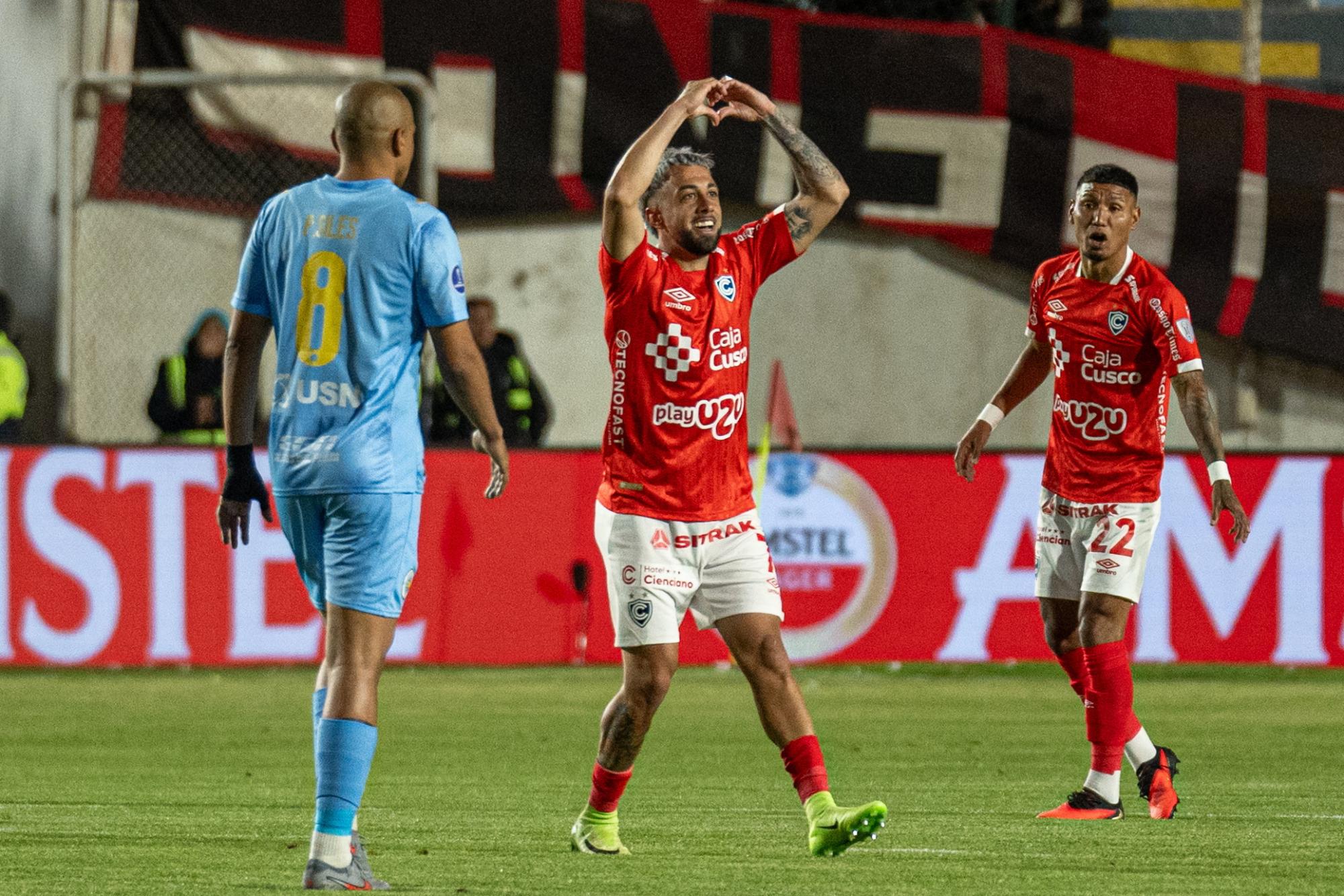
Under the Andes, Cusco traded its tourist glow for football fever as 30,000 fans packed the Garcilaso de la Vega stadium, eclipsing even Machu Picchu.
Cienciano, the city’s premier side, opened the Copa Sudamericana quarter‑final first leg, marking 23 years since they first lifted a continental trophy for Peru.
Victor Estrada, 44, cheered wildly as the starting XI strode onto the pitch, asking, “Don’t you love a tale that proves you once ruled the elite?”
For locals, it’s more than a match; it’s identity. A small club can still dream big when the Sudamericana beckons.
British roots run deep: English teacher William Newell introduced the game at Cusco’s National School of Science and Arts after independence, founding what became Cienciano, which debuted in 1902 and lingered in amateur ranks for seven decades before turning pro in the early ’70s.
Hours before kickoff, the historic school—one of Peru’s oldest republican institutions—stood silent, its walls adorned with Sudamericana trophies and player murals, echoing the club’s 11,030‑ft home altitude.
Fans surged in, drums thundering, banners proclaiming “Papá de América.” Their red kits clashed with the Plateresque Church of San Francisco and a brooding sky, forming the fierce “La Furia Roja” barra brava.
Many admitted they missed the 2003 triumph, yet stories of an invincible Cusco side persist; the IFFHS even crowned Cienciano world’s best team for December 2003.
Paolo Sosa argues the 2003 run lifted a nation bruised by political turmoil, uniting Peru beyond a mere school or city team, as he details in his new rivalry chronicle.
“Peru was drowning in scandal, then a provincial club toppled the continent’s giants,” Sosa notes. “Cienciano scripted the most epic chapter in our sport, and that memory still burns bright.”
Only Universitario and Sporting Cristal have ever reached an international final, but Cienciano’s 2003 Sudamericana win stunned Boca Juniors in the Recopa, a feat I consider the purest underdog triumph.
The 2003 squad averaged 28 years, operated on a shoestring budget and had never clinched a domestic title, yet they dispatched Chile’s Universidad Católica, Brazil’s Santos and Colombia’s Atlético Nacional before shocking River Plate in a two‑leg final staged in Arequipa for capacity reasons.
As the whistle loomed, Estrada watched La Furia Roja burst onto the north stand, the atmosphere electric. He recalled traveling with the supporters to Arequipa for the club’s greatest night.
“We had no cash, but a train ride on the roof got us there,” he reminisced. “Cienciano was my school, my team, and the winning goal made the trek worthwhile.”
“Some call football just a game, yet they miss how a club defines you,” he declared. “If we reach the final again, I’ll follow wherever, hoping not to camp in a park this time.”
Since 2010 the club has floundered financially, dropping to the second tier in 2015 before returning four years later. Despite rivals like Cusco FC and Deportivo Garcilaso, Cienciano remains among Peru’s top five fanbases.
Ahead of the first leg, tens of thousands believed history could repeat; Cienciano had already dispatched Lanús, the 2025 Sudamericana champions, and Brazil’s storied Botafogo en route to the quarter‑final.
With a two‑goal lead in the final five minutes, supporters urged more fire, hoping to widen the margin before Thursday’s away leg in Uruguay, as the visitors held firm against premature celebrations.
Chants rose in Spanish and Quechua, the most spoken Andean tongue, climaxing with a unified “¡Sí se puede!” – a rallying cry that still begs: will Cienciano carve another impossible path?