
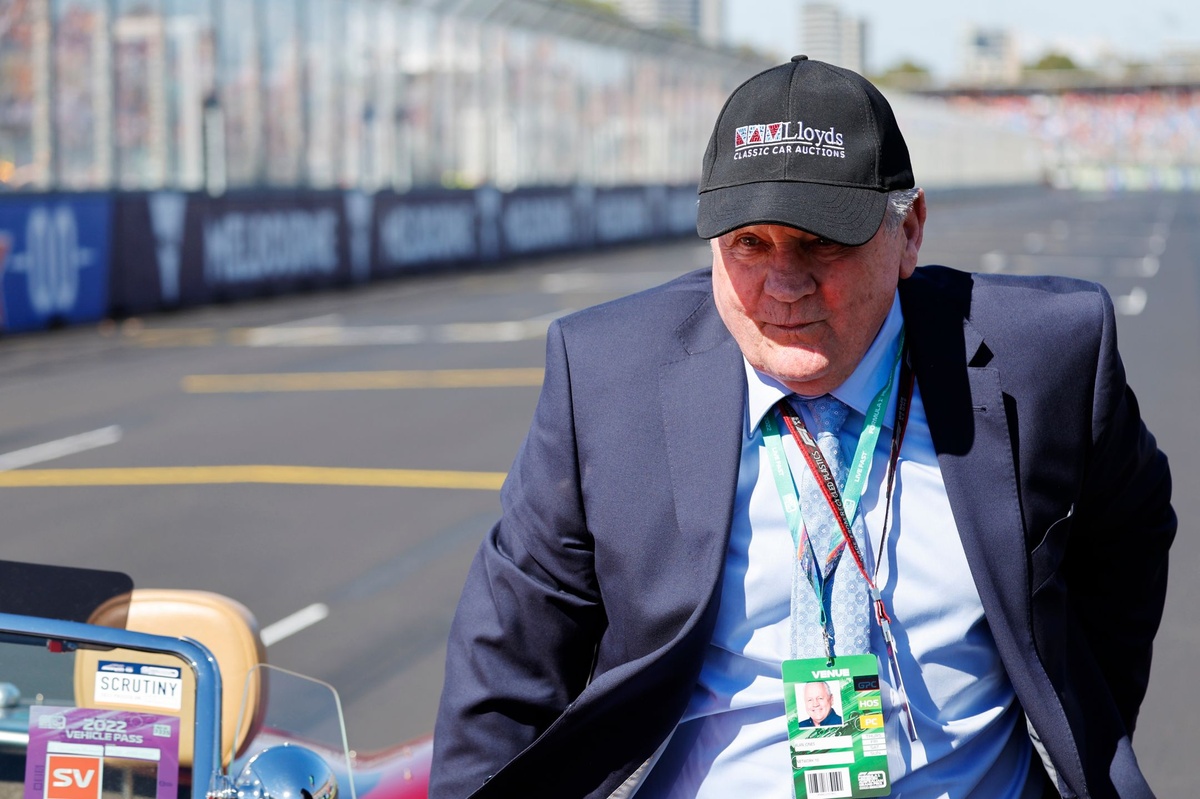
Alan Jones, 1980 F1 world champion, passed away on the Gold Coast aged 80.
A family statement quoted his wife, Amanda Butler‑Davis, saying he succumbed to a brief illness on Thursday.
“We are deeply saddened to announce Alan’s passing on 5 November after a short illness,” Butler‑Davis said. “He will be dearly missed by loved ones and countless fans who always felt his gratitude for their support.”
“Alan devoted his life to motorsport, crafting a legacy that lives on through the many he inspired along the way.”
“His achievements, passion and unmistakable character, on and off the track, left an indelible mark worldwide.”
“As a family we thank everyone who shared Alan’s journey, offering years of friendship, love and support. He was truly fortunate to be surrounded by such wonderful people.”
Born in Melbourne in 1946, Jones was the son of racer‑businessman Stan Jones and watched his father win the 1959 Australian Grand Prix at Longford. He later repeated the triumph at Calder Park in 1980, remaining the last Australian to win that historic race.
Frank Dernie, Frank Williams and Alan Jones
Jones tried his hand at UK racing in the 1960s before heading back home, then moved to London in 1970. Three years later he clinched his first Formula 3 victory at Silverstone and finished runner‑up in the British F3 championship driving a GRD.
He debuted in Formula 1 at the 1975 Spanish Grand Prix for Hesketh; when that team folded he switched to Graham Hill’s outfit, then to Surtees.
After Surtees also folded, his career seemed stalled until Shadow called, having lost Tom Pryce in South Africa. In a fairy‑tale drive on a wet Austrian circuit, Jones passed Niki Lauda to claim the first Australian win since Sir Jack Brabham.
Ferrari explored him for 1978, but after Enzo signed Gilles Villeneuve, Jones accepted an offer from the fledgling Williams team.
Jones nearly captured the Williams FW06 at Long Beach, hampered by a broken wing, then again at Brands Hatch when a gearbox failed. At the US Grand Prix he finished second to Carlos Reutemann’s Ferrari while the new FW07 was still being built. In my view, his swift dominance cemented his legend.
Once Jones and new teammate Clay Regazzoni got the FW07, they looked like winners immediately. A water‑pump failure at Silverstone handed Regazzoni the team’s first victory, after which Jones won four of the remaining six races, finishing third in the championship behind Jody Scheckter and Gilles Villeneuve.
Jones secured five Grand Prix victories in 1980 – Argentina, France, Britain, Canada and the USA – clinching the world title and capping the year with a non‑championship win at Calder.
Alan Jones, Williams FW07B Ford
In 1981 he kept Williams in contention, delivering the constructors’ crown and challenging Nelson Piquet for the drivers’ title. He won only at Long Beach and Las Vegas, and a string of DNFs plus travel fatigue prompted his retirement at season’s end.
He returned briefly, racing an Arrows at Long Beach in 1983, sat out 1984, then joined Beatrice‑Haas for three Grands Prix in 1985 and a full season in 1986, but added no further wins before retiring again.
Back home he competed in V8 Supercars, peaking with a second place in 1995, and also tackled sportscars at Le Mans with Porsche and Toyota, as well as CART with Newman‑Haas, making his final professional start in 2002 as a Bathurst 1000 co‑driver for Dick Johnson Racing.
Alongside racing, Jones built a respected media career as a commentator for Australia’s Formula 1 TV broadcasts, never shying away from blunt, honest commentary.
He received an MBE for services to motor racing in 1980 and was inducted into the Sport Australia Hall of Fame in 1985.
He is survived by his wife and six children: Christian, Amber, Zara, Jack, Camilla and Emma.
We’d love your input!
Share your ideas with us.
Take our 5 minute survey.
– The Team